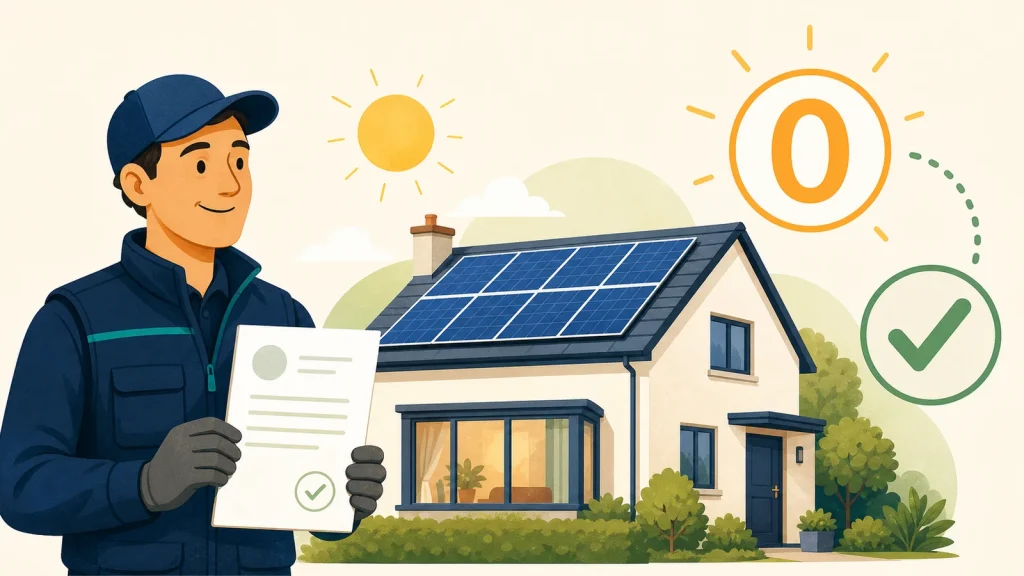
Usually, you should not need to claim it back. For a qualifying home system supplied and fitted by the installer, the installer normally charges 0% VAT on the quote and invoice until 31 March 2027.
If you see 20% VAT: ask the supplier to explain the VAT treatment and correct it if it is wrong. There is no general homeowner claim form for this relief. Equipment bought without installation is normally standard-rated, so a separate retailer charge is not usually covered by the installation relief.
For a qualifying fitted home system, the supplier normally applies the VAT rate on the invoice.
Which VAT situation matches me?
Choose the closest situation. This is a quick guide to HMRC’s published rules, not personal tax advice.
An installer is supplying and fitting new solar panels at my home
This will usually be charged at 0% VAT under the temporary relief that runs to 31 March 2027. The installer applies the rate to the quote and invoice. You do not normally pay 20% and then use a general homeowner reclaim form.
I am buying panels or parts without installation
A supply-only purchase is normally standard-rated. If you later pay a different business to install the equipment, its installation service may qualify, but that does not change the VAT already charged by the retailer.
I am adding a battery to my home
From 1 February 2024, qualifying installed electrical storage batteries are included in the temporary 0% relief. HMRC includes batteries added to solar and standalone batteries that store grid electricity. Ask the installer to state the VAT rate on the quote.
My quote includes roof repairs or other building work
Work that is only needed to complete one qualifying solar installation may follow that installation’s VAT treatment. Separate or unrelated building work can be treated differently. Ask for an itemised quote and a written explanation of the VAT used.
This is a repair or maintenance visit
A repair is not automatically the same as a new qualifying installation of energy-saving materials. Ask the repair company to show the VAT basis on its quote. Get professional tax advice if the job combines repair, replacement and new installation work.
My job may finish after 31 March 2027
HMRC’s current notice says qualifying installations move to the reduced 5% rate from 1 April 2027. Ask the installer which tax point applies and make sure the contract explains what happens if the VAT rate changes before completion.
Some solar panels and batteries fitted in homes have 0% VAT until 31 March 2027. This can lower the total price.
Quick answer: the relief is mainly about the supply and fitting of approved energy-saving products. Buying equipment on its own can be treated in a different way.
The fitting work matters
Ask the installer to show the VAT rate on the quote and invoice. Do not assume that every solar product or building job has 0% VAT.
What can be included?
HMRC guidance covers fitted solar panels and parts needed for them to work. This can include cables, controls and the inverter. Some extra work may be included when it is part of the same job. Unrelated building work may not be.
What about batteries?
Electrical storage batteries can also qualify in the cases set out by HMRC. This can include a battery fitted with solar panels or fitted on its own.
What changes after March 2027?
Current guidance says the rate should move to 5% from 1 April 2027, unless the law changes. If your work may finish near that date, ask the installer which rate will apply.
Questions for your quote
Does the total price include VAT?
Which parts have 0% VAT?
Is roof or electrical work part of the same job?
How is the battery treated?
What happens if the finish date moves past 31 March 2027?
This is general information. Ask the installer to explain the tax on your own job. Get tax advice if the answer is not clear.