
How Many Solar Panels Do I Need in the UK?
A sensible panel count starts with annual electricity use and roof constraints, not the number of bedrooms. For many homes the practical question is: what array fits the usable roof, and how much of its generation can the household use or export?
The quick calculation
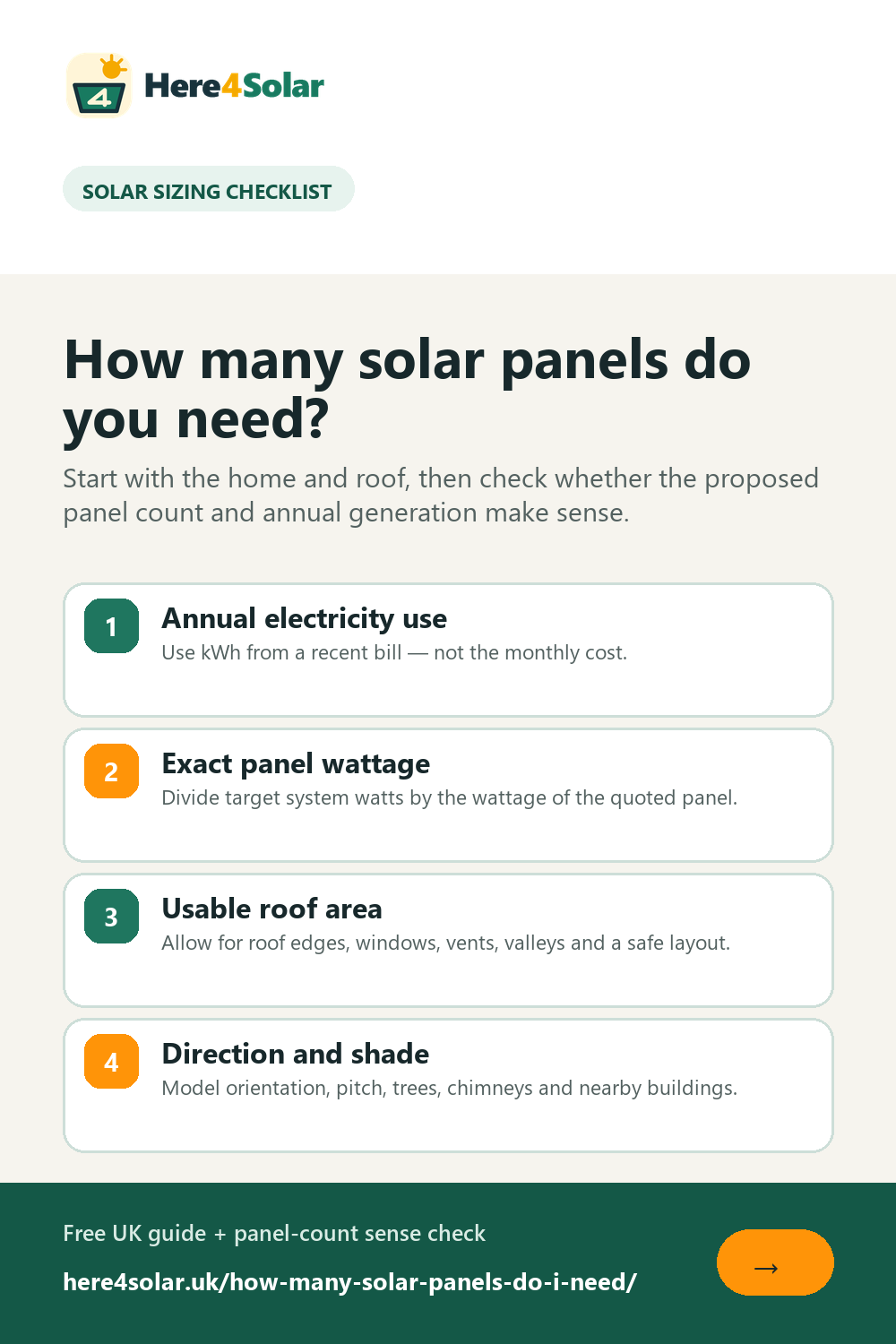
Divide the target system size in watts by the rated wattage of one panel. For example, a 4kWp design using 440W panels needs about 9 panels because 4,000 ÷ 440 is 9.1. The installer then checks whether that layout actually fits, meets electrical limits and avoids excessive shading.
Start with annual use
Find annual kWh on a recent bill. Monthly cost is a poor substitute because tariffs change. Electricity used during daylight has more value than electricity exported at a lower rate, so two homes with the same annual total may suit different designs.
Measure usable roof, not total roof
Panel dimensions vary, but modern modules are large rectangles and need safe clearances around roof edges, ridges, valleys, windows, vents and obstructions. Ask for a scaled layout showing the exact panel model and dimensions.
Orientation, pitch and shade
South-facing roofs usually maximise annual output, but east-west arrays can spread generation across the day and may align better with household use. Shade from trees, chimneys and nearby buildings should be modelled by time of day and season. A single percentage without an explanation is not enough.
Use yield to sense-check the design
Annual generation is commonly estimated by multiplying kWp by location-specific yield and applying losses. PVGIS can provide a location and orientation estimate. The Energy Saving Trust calculator gives a homeowner-friendly second opinion. Neither replaces a survey.
Do not size the battery first
Choose the array and understand the household load before deciding battery capacity. A battery cannot create electricity; it only moves generation or off-peak imports to a different time. Ask for panel-only and panel-plus-battery cases using the same assumptions.
Allow for future electricity demand
An EV, heat pump, home working or electric hot-water system may increase annual use. Bigger is not automatically better, but the quote should show whether future demand changes the recommended array, inverter or network application.
Panel-count checklist
- Annual household electricity use in kWh.
- Daytime and seasonal usage pattern.
- Exact panel wattage and dimensions.
- Usable roof area and a scaled layout.
- Orientation, pitch and quantified shade.
- Expected annual kWh and the yield source.
- Inverter AC rating and export limit.
- Future EV, heat-pump or occupancy changes.
Shareable visual summary
Use this graphic in a relevant article, community resource, presentation or social post. Please keep the wording intact and include visible credit with a link to this guide.
How many solar panels do I need - UK sizing checklist
Usage note: You may use this image if you credit and link to this page.
Suggested attribution: Here4Solar.uk - https://here4solar.uk/how-many-solar-panels-do-i-need/
Suggested attribution
Source: Here4Solar.uk - https://here4solar.uk/how-many-solar-panels-do-i-need/
Sources and official guidance3
Check the forecast behind the panel count: use the quoted-yield calculator to compare annual kWh per kWp.
Before the final layout: use the four-nation solar planning guide to check roof, listing and protected-area rules.